
How Sēk Strategies Works
A lot of accountability work begins with a familiar problem.
The evidence is there, but it is scattered. The harm is visible, but responsibility is unclear. The policy commitment exists, but implementation is weak. The money, ownership, governance, and decision-making structures sit behind the issue, often just out of view.
That is where Sēk Strategies works.
Sēk Strategies helps organizations understand where money, harm, and governance failures intersect, and what can realistically be done before risks escalate.
This work is not only about documenting harm. It is about understanding how harm is enabled, financed, justified, obscured, minimized, or allowed to continue.
In practice, that means following the connections.
A biodiversity threat may also be a financial-sector issue. A human rights concern may also be a procurement, safeguard, or investor exposure issue. A corporate accountability problem may depend on ownership structures, supply chains, public finance, political relationships, or the gap between what institutions say and what they do.
When these issues are treated separately, accountability becomes harder to pursue.
The aim is to build interlinked risk profiles, not issue silos.
Most of my work begins with a signal that something is wrong, when the full picture is not yet clear. A community raises concerns about a project. A financier is linked to environmental or human rights harm. An ownership structure is opaque. A supply chain is difficult to trace. A policy commitment is not translating into practice.
At that point, the most useful questions are practical. Who is connected? Who benefits? Who enables? Who is exposed? Who has leverage? What decision can still be made?
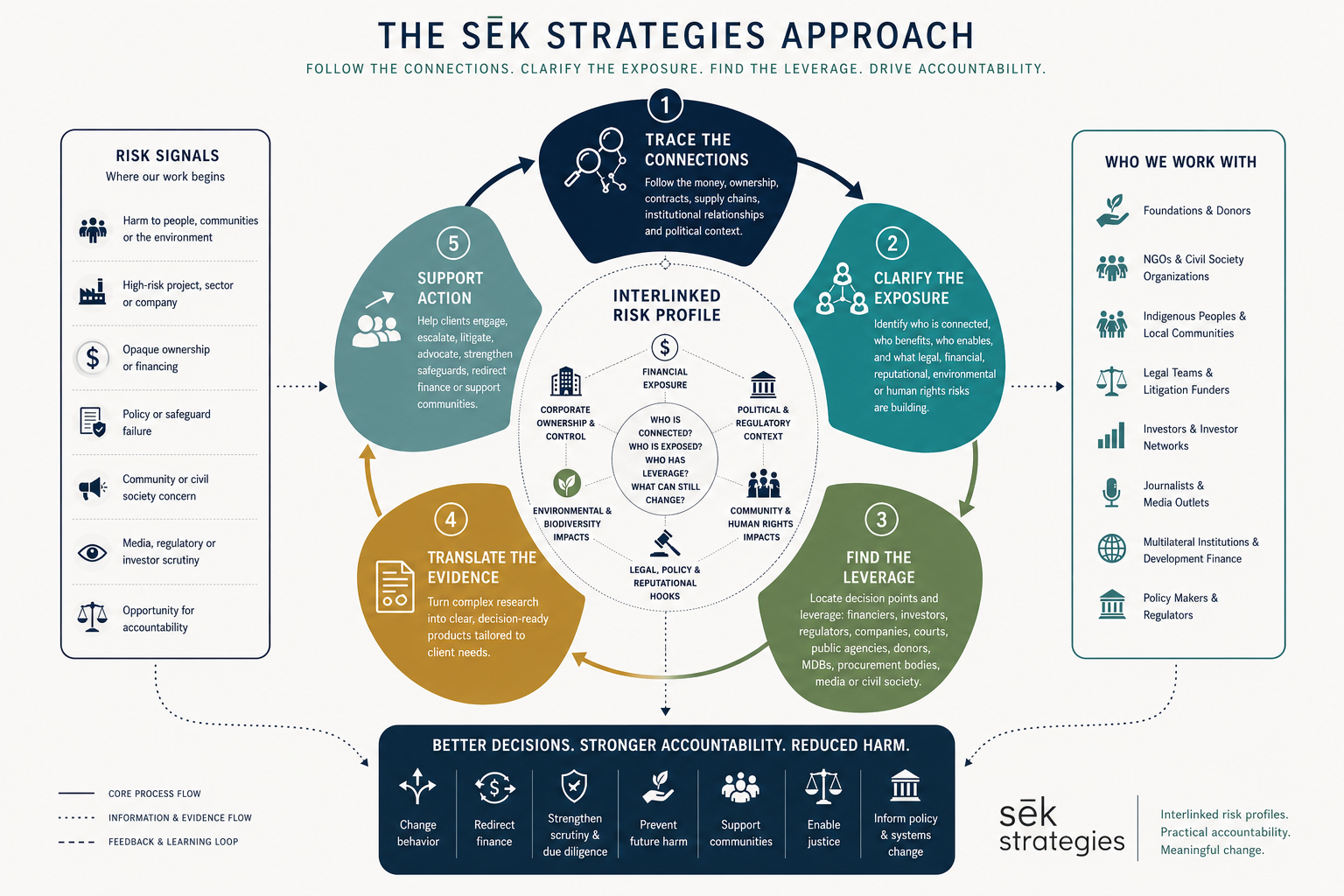
How Sēk Strategies turns scattered evidence into a clearer accountability route.
Sēk Strategies traces the relationships behind harmful activity. That means looking beyond the visible actor to understand who controls or benefits from a company or project, how money and ownership are structured, which institutions shape the outcome, and where responsibility or leverage may sit.
The purpose is not to gather information for its own sake. The purpose is to understand how the system around the harm is operating, who has the power to change it, and what openings still exist for action.
The visible actor is not always the only actor that matters.
A company may be closest to the harm, but the leverage may sit elsewhere. A financier may have due diligence obligations. An investor may have influence. A public agency may hold the decision point. A regulator, buyer, donor, court, or multilateral institution may be better placed to act.
Accountability depends on seeing that wider field clearly.
That is what an interlinked risk profile is meant to do. It looks across legal, financial, environmental, human rights, governance, safeguard, procurement, investor, and policy exposure to understand how risks build, who is positioned to respond, and where action could still change the outcome.
Evidence alone does not create change. It has to be defensible, clearly structured, and connected to the systems where decisions are made.
There is rarely one strategy that moves everything. Change usually depends on knowing which levers exist, which actors can use them, and how different forms of action can reinforce each other over time. Public scrutiny may matter, but so can quiet engagement with a financier, a well-timed intervention in a safeguard or due diligence process, a legal or regulatory route, a funder decision, or coordinated coalition action.
Sēk Strategy’s role is to make that complexity usable. Depending on the need, that may mean a rapid risk memo, capital and exposure map, private briefing, stakeholder strategy, litigation support, advocacy framing, or escalation pathway. It can also mean helping clients coordinate action across stakeholders so evidence does not sit still, but moves through the institutions and relationships where change is possible.
The method is simple. Follow the connections. Clarify the exposure. Find the leverage. Translate the evidence. Support action.
Because when the connections are visible, decisions become clearer. And when decisions become clearer, accountability becomes more possible.